Behavioral Healthcare: Designing Safe Spaces for Healing


Modern behavioral health design is a delicate balancing act: it requires creating a space that's welcoming, calming, and comfortable while maintaining strong safety standards to protect everyone who enters the facility.
With more than three decades of experience in hospital and behavioral health design, TMP understands the nuance of this particular category of healthcare, listening, collaborating, and implementing every facet of patient service into design, allowing the space to assist in a patient's healing.

Safety by Design
Physical safety through anti-ligature design is the number-one priority in a behavioral health facility. Oftentimes, a patient entering the facility inherently wants to do harm to themselves or others. To keep everyone safe, a building must be comfortable yet resilient. It should contain abuse-resistant safety elements while never giving that impression — feeling open, airy, and inviting. Class-A, protected materials that don’t feel institutional are necessary, with ligature-resistant design required in any space a patient might occupy, including the exterior courtyards.
“Hospitals require complex layers of information for a completed design like code regulation, department requirements, and security, all while keeping the patient, visitor, and staff experiences top of mind," says Jim Pareigis, Senior Associate. "Behavioral health hospitals have to meet those along with additional demands like security zoning, safe designs for patient/staff interaction, and special locking arrangements."
Security zoning ranks how secure spaces are. Staff-only spaces are the least secure while seclusion suites are the most secure. Safe design for an office or consult area would put staff nearest to the door. Special locking arrangements keep patients within designated areas that are open for their use and out of other areas that require staff entry.
"The environment is restrictive, but how a design achieves security can be completed in ways that are invisible, but safe," Pareigis says.
Staff support spaces are often located directly off a nurse station versus patient areas so staff can have access to support, nourishment, medications, and dictations in a secure space.
Paying attention to nurse station sightlines is another key consideration. Nurses should be able to see down corridors, into public areas, and other patient areas easily. At the same time, patients shouldn't feel "cornered" in a space. Having clear sightlines has a positive psychological impact on them too. The Knoxville Center for Behavioral Medicine is a perfect example of an efficient layout, with the nurse station located in the center of the patient area.
Keeping the nurse station open was important for the owner, but safety wasn't disregarded. TMP adjusted the height and depth of the station counters so staff and equipment are protected while achieving the client's goal.
“The nurse station was positioned to view corridors and social spaces for safety, and we intentionally created spaces for patients that can be observed by the staff,” Pareigis says.

Knoxville Center for Behavioral Medicine nurse station
Highly Adaptable
Because mental health doesn’t discriminate, facilities need to be adaptable for a range of abilities, sizes, mobilities, and diagnoses. Whole rooms might need to be converted for different uses. That needs to be planned for at the beginning of design and often leads to very similar room layouts throughout the facility.
Modular furniture, identical patient room design, and spaces that can be used for various purposes — like therapy, activity, and more — are examples of flexible design.
Patients should have a sense of choice and autonomy. Outdoor space, activity rooms, dining rooms, game rooms, quiet spaces, reading nooks, and more give them freedom while learning and healing. Within these spaces, acoustic elements that provide noise control is an example of designing to reduce sensory overload for patients, which can become triggering.
Interiors Evoke Healing
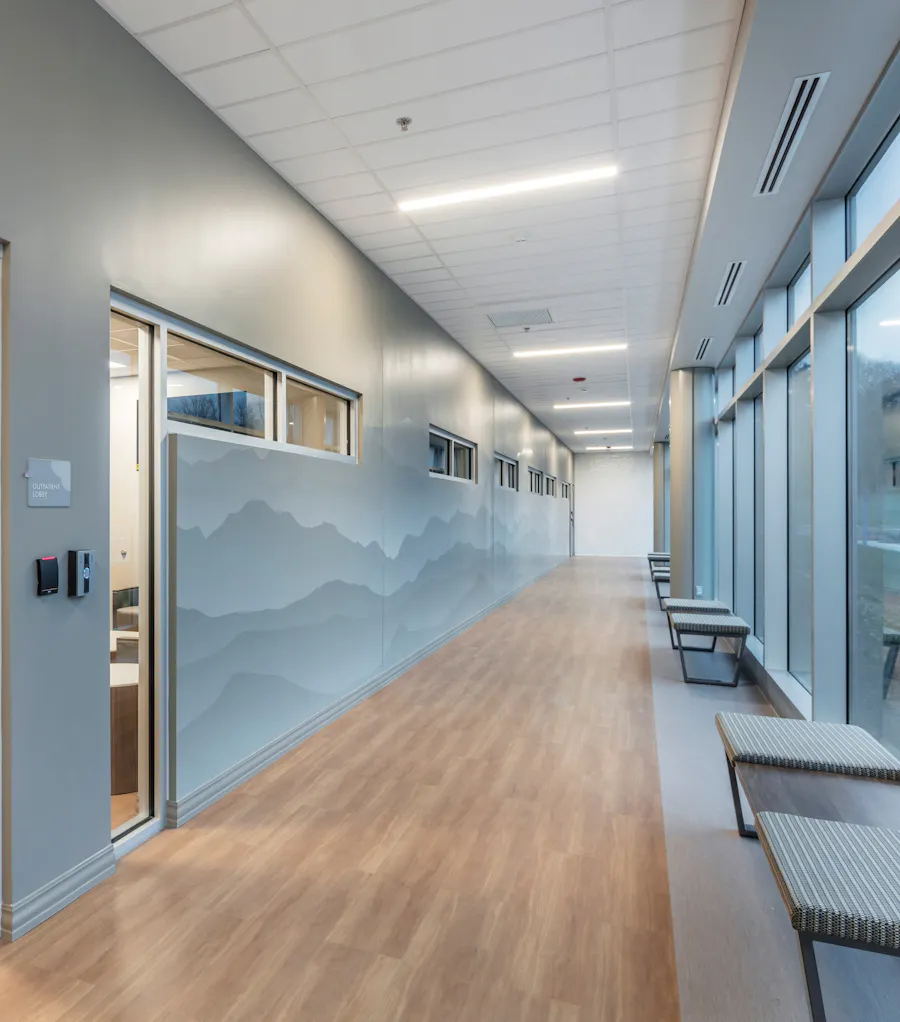
A serene beach scene. Stunning images of sunsets. Soothing colors used in artistic elements like light fixtures. Interior choices play a major role in behavioral health facilities, providing a calm, healing environment for patients. A facility should never feel institutional, and wherever possible, natural light provides benefits for both patients and staff.
The nurse station at Pinewood Springs in Columbia, Tennessee, was deliberately placed underneath a skylight that offered ample natural light, which flowed into nearby public spaces. Natural light has been shown not only to help with mood regulation, but also circadian rhythm regulation. Patients in behavioral health environments often have disrupted sleep, so natural light doubles as a clinical tool.
In patient rooms, elements like desks allow them to journal and a touch-light above the bed could be included for reading. Furniture needs to be comfortable, but also tamper-resistant, easy to clean, and prevent self-harm.
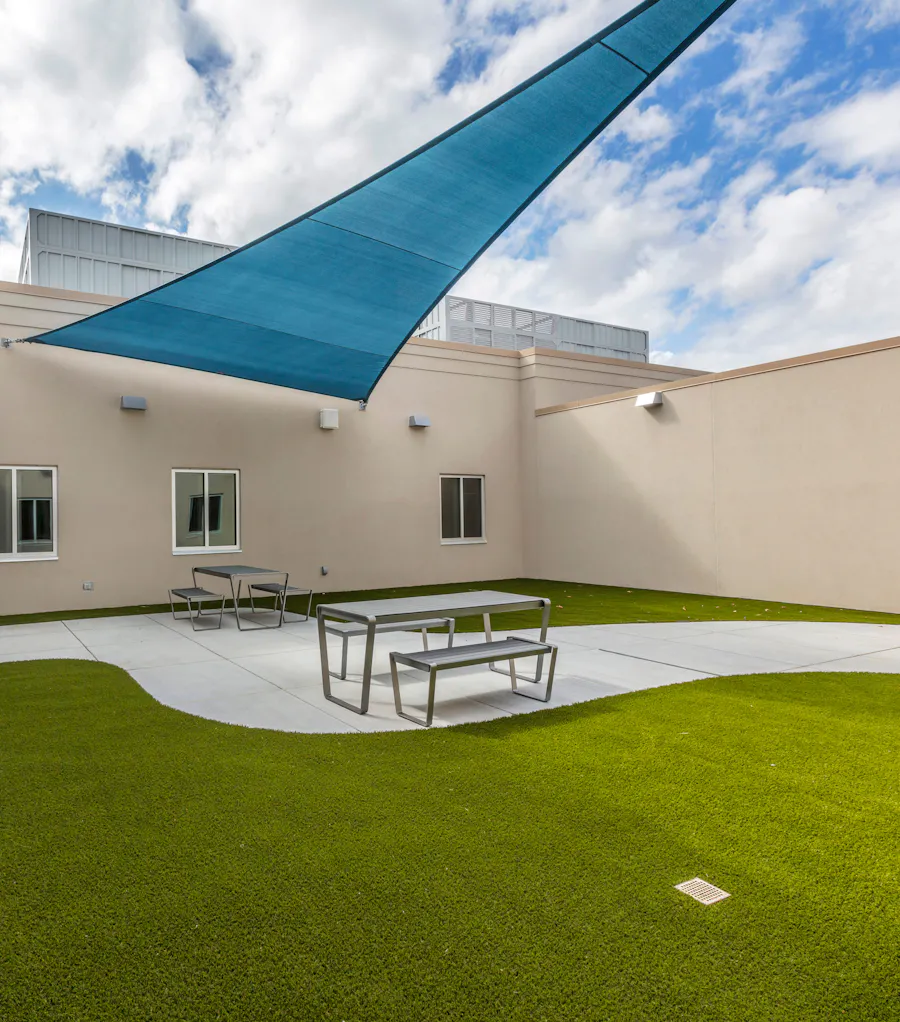
Outdoor courtyards are included when possible, giving both patients and staff a place to retreat with fresh air and sunlight.
“These facilities need to be a place where patients can feel human and have dignity while they’re going through the healing process,” Pareigis says. "Our design directly plays into that."
Learn more about TMP’s behavioral healthcare experience — and other healthcare projects — here.